
1.3 — Regulation
Soil regulates climate: Earth's carbon reservoir
Page 1 / 5
What is the largest organic carbon reservoir on land?
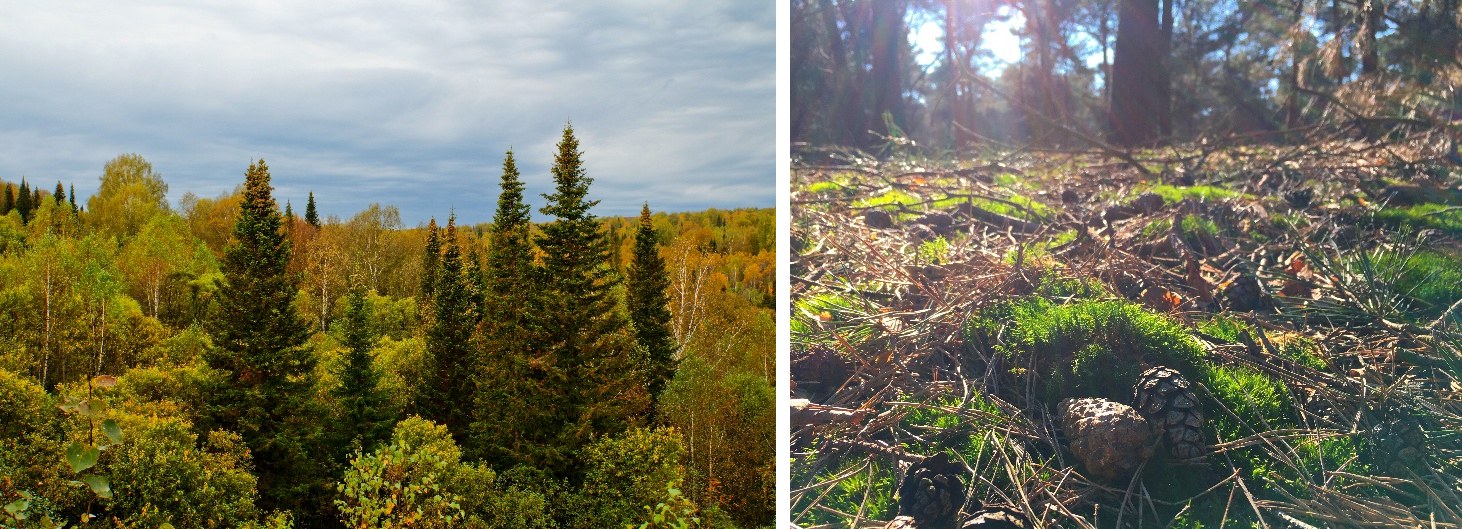
Left: © Mixed forest and clouds by Anatoly Bortnikov, CC BY 2.0, the photo was cut on both sides.
Right: © Forest floor by Industrees, CC0 1.0 , no changes were made to the original photo.
When people think of carbon storage, they often picture forests and trees. However, a large proportion of the carbon stored in terrestrial ecosystems is found below ground, making soils one of the Earth's most important carbon reservoirs.
Globally, soils are estimated to contain more carbon (1500 Pg C) in the top 1 m than the atmosphere (800 Pg C) and about three times as much as all terrestrial vegetation combined (500 Pg C) (FAO, 2017). This carbon is held mainly in soil organic matter – the remains of roots, leaves, animal remains and countless microorganisms that have accumulated over hundreds or even thousands of years.
Rather than being a static container, soil is constantly exchanging carbon with plants and the atmosphere. Every growing season, plants remove carbon dioxide from the air through photosynthesis. Part of this carbon becomes roots and plant residues, which enter the soil. At the same time, soil organisms decompose organic matter and release carbon dioxide back into the atmosphere through respiration.
One way to think about this process is as a climate bank account. Plants make deposits by adding carbon to the soil, while decomposition makes withdrawals by releasing carbon back into the atmosphere. Whether the balance grows or shrinks determines whether soil acts as a carbon sink, storing more carbon than it releases, or a carbon source, releasing more carbon than it stores. When soils gain more carbon than they lose over a prolonged period, they sequester carbon.