
3.3 — Biodiversity loss
Soil protists — the invisible engines of ecosystems
Seite 5 / 7
Exploring protist climate preferences and environmental adaptations
Because protists respond quickly to changes in their environment, soil protists have the potential to be used as biological indicators of soil status.
- Drought and heat: protists need water in the soil to be active. Therefore, during drought, protists are less active and survive as cysts.
- Waterlogging and flooding: living in wet soils is not challenging for protists. However, their success depends on the duration of flooding and oxygen availability. Water movement through the soil pore system facilitates protist dispersal over longer distances in wet soil than in dry soil.
- Peak activity: protists do well in continuously moist soils. Their activity depends not only on water in the soil but also on oxygen, nutrient distribution and depth in the soil.
Fun fact: Photosynthetic protists (e.g., microalgae) capture carbon from the atmosphere and fix it in soils, especially in arid environments where plants are scarce. Soil algae contribute roughly 6% of terrestrial carbon fixation by vegetation (Jassey et al., 2022).
Fun fact: Diatoms and testate amoebae absorb elements such as silica and phosphorus into their cells. When they die, these minerals are released, fuelling soil nutrient cycles (Puppe, 2020).
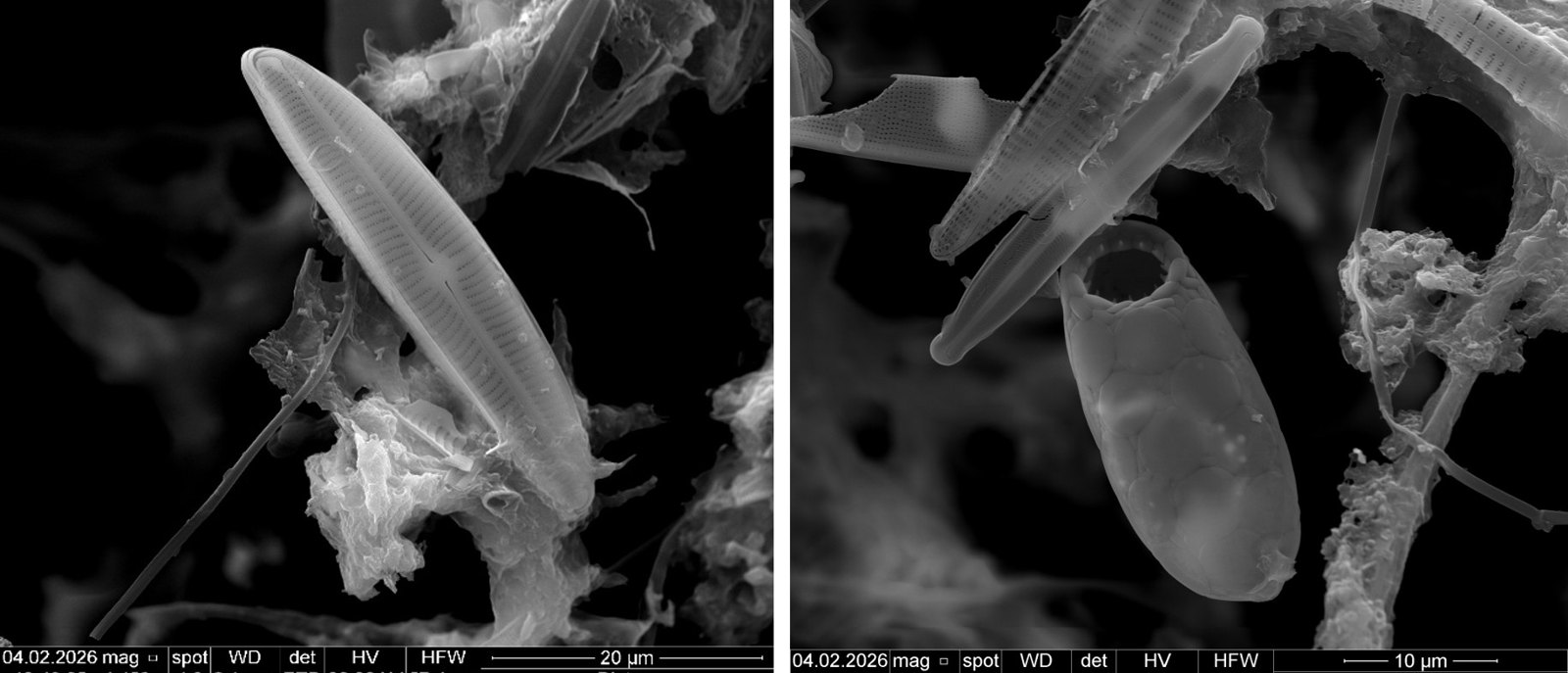
© Microalga (left), two different microalgae species and testate amoeba (right) by Lea Wellinger and Leon Ploszczanski, BOKU University.