1.6 Soils in a connected world
Synthesis: The case of peat
Page 1 / 8
What are peatlands?
Peatlands are wetland ecosystems where dead plant material accumulates faster than it decomposes. Over hundreds to thousands of years, this process forms peat – organic soil rich in carbon. Although peatlands cover only a small proportion of Earth’s land surface, they are among the planet’s most important ecosystems for climate regulation, biodiversity, water storage, and environmental history.
Peatland ecosystems are very diverse and occur in all climatic zones and on every continent, from the Arctic to Sub-Antarctic and from sea level to high alpine environments. They are commonly divided into two basic types: bogs and fens. Bogs are fed almost exclusively by rainfall and snow, while fens are usually low-lying and are primarily fed by groundwater and surface runoff. Even though many people use the two terms (bog and fen) interchangeably, they have unique environmental characteristics that support entirely different plant, insect and bird communities as well as different soil services. The numerous important soil services provided by peatlands are essential for achieving several Sustainable Development Goals (SDGs) for e.g., support for livelihoods, freshwater supply, clean air and flood protection.
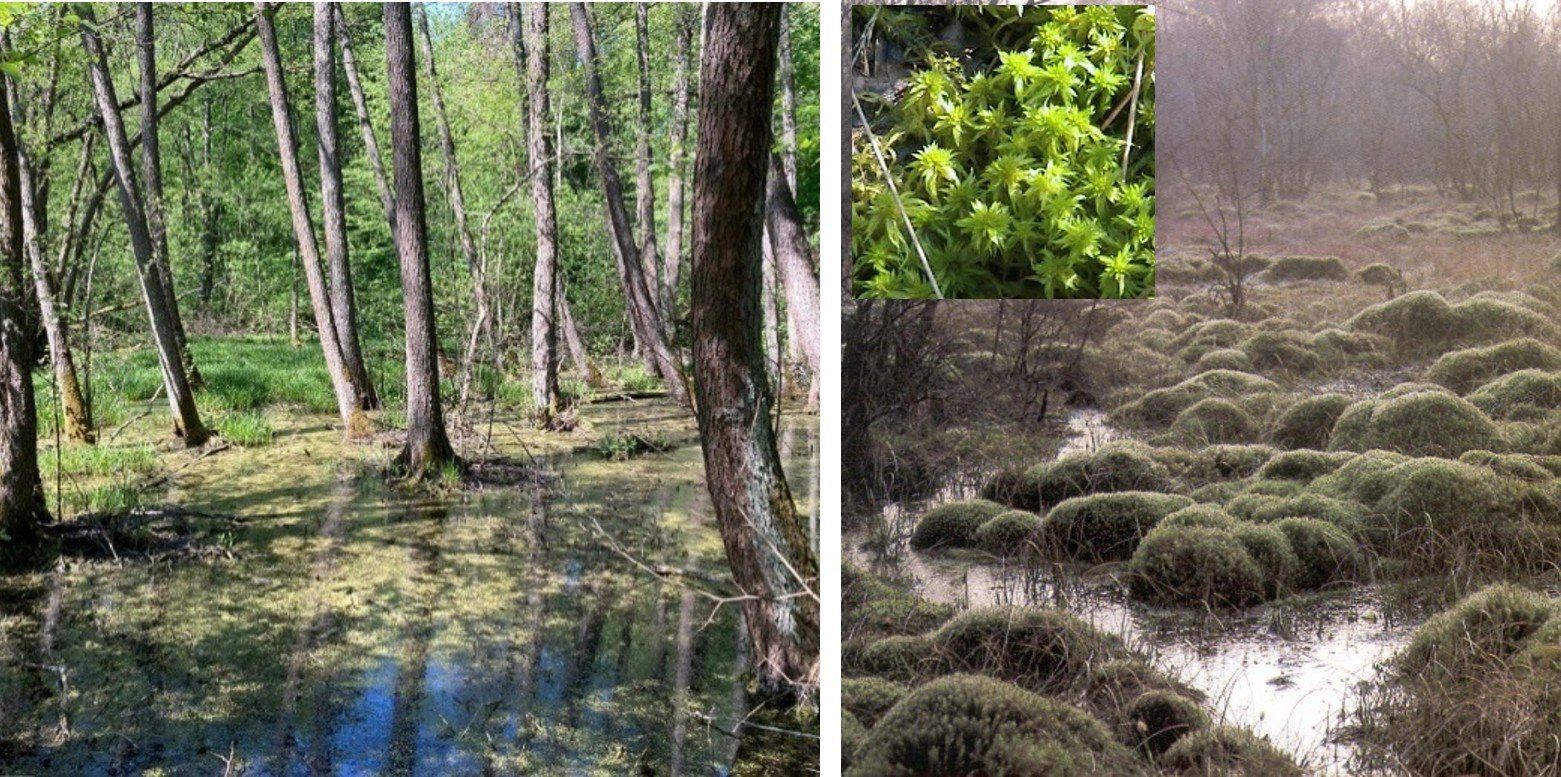
Left: © Swamp forest (or a groundwater- and river-fed fen) near Stockholm, Sweden, by Ingrid Lubbers, WUR.
Right: © Rain-fed bog with spreading Sphagnum mosses, photo archive of the Soil Geography and Landscape group, WUR. Inset: © Sphagnum close-up by Meindert van den Berg, TNO.
Soil services provided by peatlands. This is not an exhaustive list.
- Provisioning: Peat extraction, forestry, food products, medicine
- Regulating: Carbon storage, water regulation
- Supporting: Habitat supporting specialized biodiversity
- Cultural: Archaeology, spiritual value, landscape identity
- Archive: Preservation of pollen, bog bodies, climate records
Peatlands continue to be lost at alarming rates, despite their importance for the climate, people and the planet. The use of peatlands for vital functions and essential services is making them highly vulnerable. Therefore, decisions about peatland management often involve trade-offs between competing soil services and stakeholder interests.
In order to protect peatlands effectively and make sustainable decisions about their future use, it is important to understand the different soil services that peatlands deliver. Such understanding can help address conflicts between different stakeholders and land uses, such as economic utilization and environmental conservation, in a balanced and rational way.