Greening the curriculum: Soil Literacy Integration
Conclusion
Page 1 / 1
Conclusion
Greening the curriculum is not a single ambitious overhaul; it is a slow, deliberate weaving. The eleven ideas above are deliberately uneven on purpose — some are a single lab session, others are a year-long programme. That range is the point. Pick the smallest one that excites you and ship it well. A successful soil-erosion demo in one Science lesson, witnessed by colleagues, will recruit more advocates than a glossy whole-school strategy ever could.
This is the heart of the lighthouse-project approach. You don't need permission to be the school where the maths class graphs the soil composition of the playground, or where the Art teacher mixes pigments from the local subsoil. You need one teacher, one lesson, one visible result — and the gravity that pulls others in is its own reward. As you commit to your three sentences below, resist the urge to be heroic. The 1-week version of your idea is more valuable than the 1-year version, because it is the only one that is real today.
A final thread to pull. Each idea on the list survives or dies on whether it's shared. A composting bin nobody talks about is just a bin; the same bin, photographed and posted in the staff WhatsApp on day one, becomes a story your colleagues retell. Build sharing into every step you commit to — to a colleague, to a parent, to a student, to this Community of Practice. Soil literacy travels the way soil itself does: organism by organism, through patient root contact.
Reflection task
Choose at least one idea from the eleven above that fits your subject and school context. Then, in your own notes (and, if you're comfortable, in the CURIOSOIL forum thread for this section), finish these three sentences:
In a week I will…
One concrete action you can take inside the next seven days. Something small enough that "no time" cannot be the excuse.In a month I will…
A bigger move that builds on the first one — typically the moment a colleague or class first notices what you are doing.In a year I will…
The version of this work you would feel proud telling a new colleague about. Be ambitious here — the long horizon is allowed to be aspirational.
Text version
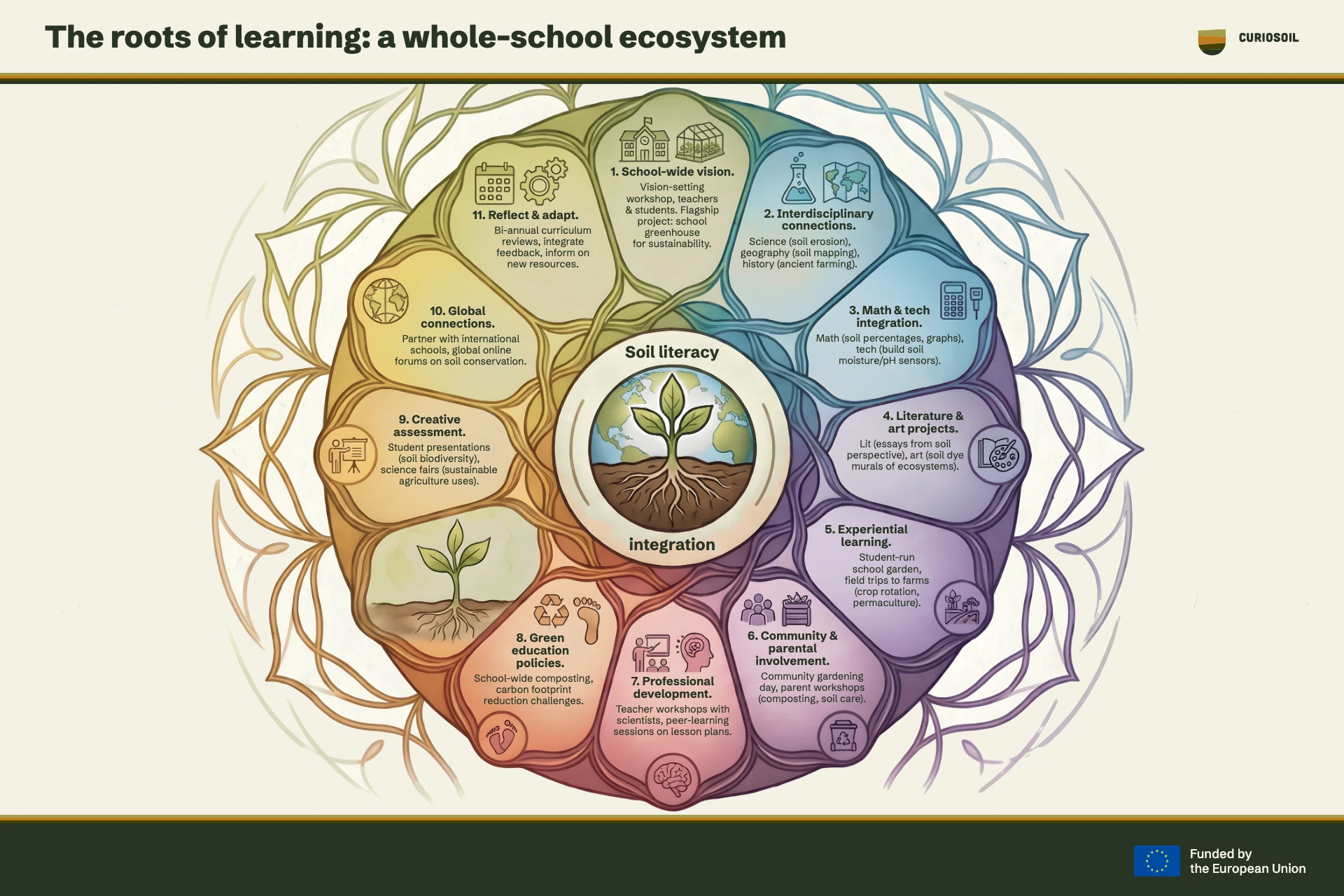
The Roots of Learning: A Whole-School Ecosystem
Soil literacy integration
- School-wide vision. Vision-setting workshop, teachers & students. Flagship project: School Greenhouse for sustainability.
- Interdisciplinary connections. Science (soil erosion), Geography (soil mapping), History (ancient farming).
- Math & tech integration. Math (soil percentages, graphs), Tech (build soil moisture/pH sensors).
- Literature & art projects. Lit (essays from soil perspective), Art (soil dye murals of ecosystems).
- Experiential learning. Student-run school garden, field trips to farms (crop rotation, permaculture).
- Community & parental involvement. Community gardening day, parent workshops (composting, soil care).
- Professional development. Teacher workshops with scientists, peer-learning sessions on lesson plans.
- Green education policies. School-wide composting, carbon footprint reduction challenges.
- Creative assessment. Student presentations (soil biodiversity), science fairs (sustainable agriculture uses).
- Global connections. Partner with international schools, global online forums on soil conservation.
- Reflect & adapt. Bi-annual curriculum reviews, integrate feedback, inform on new resources.
Closing prompt to keep with you: What is the smallest thing I can do this week that, if my best colleague walked past, they would stop and ask about? If you can answer that, your action plan has already started. 🌱
CURIOSOIL lesson plans to share with your teachers
To help your teachers get started, CURIOSOIL partners developed eight ready-made lesson plans. They are available as PDFs in 16 languages; in the Luxembourgish set, the Ethics plan is in English.
- Primary (ages 8–11, two hours): Understanding our soil – functions, diversity, health and solutions.
- Secondary (45 minutes each): Art, Biology, Chemistry, Ethics, Geography and History for ages 14–16, and Art & Drama for ages 16–18.
Download (PDF)
English: Primary · Art · Biology · Chemistry · Ethics · Geography · History · Art & Drama
Dansk: Primary · Art · Biology · Chemistry · Ethics · Geography · History · Art & Drama
Deutsch: Primary · Art · Biology · Chemistry · Ethics · Geography · History · Art & Drama
Español: Primary · Art · Biology · Chemistry · Ethics · Geography · History · Art & Drama
Français: Primary · Art · Biology · Chemistry · Ethics · Geography · History · Art & Drama
Hrvatski: Primary · Art · Biology · Chemistry · Ethics · Geography · History · Art & Drama
Italiano: Primary · Art · Biology · Chemistry · Ethics · Geography · History · Art & Drama
Lëtzebuergesch: Primary · Art · Biology · Chemistry · Ethics (in English) · Geography · History · Art & Drama
Nederlands: Primary · Art · Biology · Chemistry · Ethics · Geography · History · Art & Drama
Norsk: Primary · Art · Biology · Chemistry · Ethics · Geography · History · Art & Drama
Português: Primary · Art · Biology · Chemistry · Ethics · Geography · History · Art & Drama
Română: Primary · Art · Biology · Chemistry · Ethics · Geography · History · Art & Drama
Slovenščina: Primary · Art · Biology · Chemistry · Ethics · Geography · History · Art & Drama
Suomi: Primary · Art · Biology · Chemistry · Ethics · Geography · History · Art & Drama
Türkçe: Primary · Art · Biology · Chemistry · Ethics · Geography · History · Art & Drama
Українська: Primary · Art · Biology · Chemistry · Ethics · Geography · History · Art & Drama
Each plan includes a link and a QR code to a short feedback form. If you try a plan with your class, your feedback helps the project improve it.
The Soil Curiosity Kit adds a Book of Activities, a Visual Wiki, a Video Wiki and a Soil Sound Bank that your teachers can draw on.