School project + integration + extracurricular
Integration: Maths / Arts / Music / Language / PE / Ethics / Religion / Digital
Page 1 / 1
Integration: Maths / Arts / Music / Language / PE / Ethics / Religion / Digital
Mathematics: Data analysis on soil moisture/density over time; geometry in landscaping (area, volume of soil, optimisation); statistics on local agriculture vs. soil quality.
Visual arts: Soil art projects using natural pigments; photography and storytelling about soil; analyse artworks like Albrecht Dürer's Great Piece of Turf.
Music: Compose "soil symphonies" from natural sounds; explore traditional farming songs.
Language arts: Poetry inspired by soil; debates on conservation vs. modern agriculture; analyse literary texts such as Vahni Capildeo's Porosity:
"you learn in school / little scuttling things / breathe through spiracles / you learn the skin / is the largest organ / of the human body / you won't polish / your toenails / in case your toes can't breathe / but, child, / who says / the soil has porosity?"
Foreign language: Vocabulary building; international soil practices; chronicle or opinion piece about urgent need to protect soils; children's book on soils.
Physical education: Gardening workouts; outdoor obstacle courses simulating soil conservation techniques.
Ethics: Land use ethics debate; global responsibility project; SDGs and Agenda 2030.
Religious studies: Soil in sacred texts; spiritual ecology essays.
Digital sciences: Soil data analytics with GIS; VR simulations of soil ecosystems and change over time.
Text version
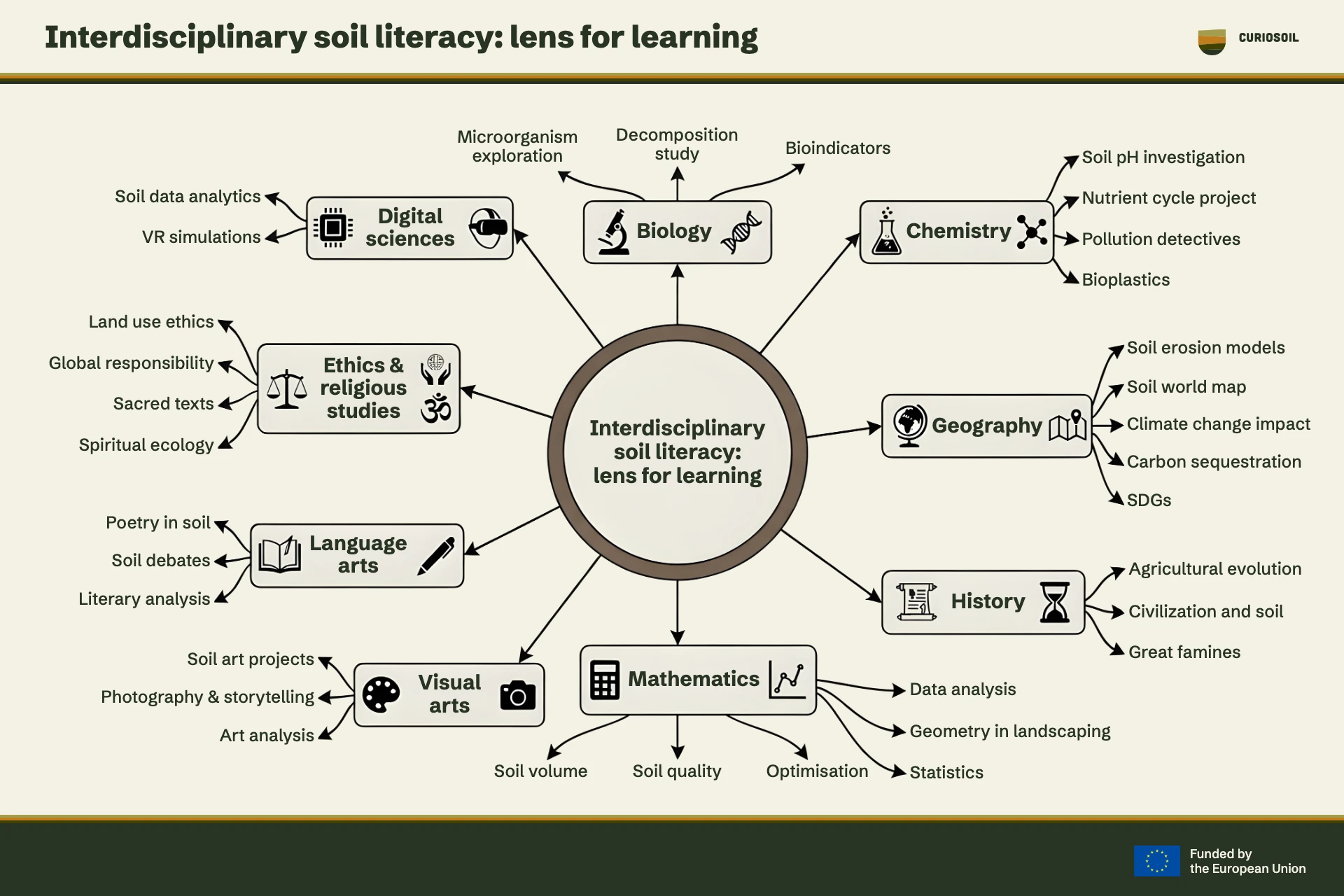
Interdisciplinary soil literacy: lens for learning
- Biology
- Microorganism exploration
- Decomposition study
- Bioindicators
- Chemistry
- Soil pH investigation
- Nutrient cycle project
- Pollution detectives
- Bioplastics
- Geography
- Soil erosion models
- Soil world map
- Climate change impact
- Carbon sequestration
- SDGs
- History
- Agricultural evolution
- Civilization and soil
- Great famines
- Mathematics
- Data analysis
- Geometry in landscaping
- Statistics
- Soil volume
- Soil quality
- Optimisation
- Visual arts
- Soil art projects
- Photography & storytelling
- Art analysis
- Language arts
- Poetry in soil
- Soil debates
- Literary analysis
- Ethics & religious studies
- Land use ethics
- Global responsibility
- Sacred texts
- Spiritual ecology
- Digital sciences
- Soil data analytics
- VR simulations
Ready-made CURIOSOIL lesson plans for your subject
CURIOSOIL partners developed seven 45-minute lesson plans that bring soil into secondary subjects. They are available as PDFs in 16 languages; in the Luxembourgish set, the Ethics plan is in English.
- Art (ages 14–16): Soil stories: painting and protecting our living Earth, the beauty and value of soil through art.
- Biology (ages 14–16): Meet the underground neighbours, soil biodiversity and its connection to human life.
- Chemistry (ages 14–16): Soil chemistry – colours and bonding, pH and nutrient availability.
- Ethics (ages 14–16): Guardians of the landscape, above and below ground, our ethical responsibility to soil.
- Geography (ages 14–16): The future map of my hometown, land use and soil in your local area.
- History (ages 14–16): Soil stories of exploration, the age of exploration and colonisation through the lens of soil.
- Art & Drama (ages 16–18): Harmony in the Earth, crafting soil stories through music and drama.
Download (PDF)
English: Art · Biology · Chemistry · Ethics · Geography · History · Art & Drama
Dansk: Art · Biology · Chemistry · Ethics · Geography · History · Art & Drama
Deutsch: Art · Biology · Chemistry · Ethics · Geography · History · Art & Drama
Español: Art · Biology · Chemistry · Ethics · Geography · History · Art & Drama
Français: Art · Biology · Chemistry · Ethics · Geography · History · Art & Drama
Hrvatski: Art · Biology · Chemistry · Ethics · Geography · History · Art & Drama
Italiano: Art · Biology · Chemistry · Ethics · Geography · History · Art & Drama
Lëtzebuergesch: Art · Biology · Chemistry · Ethics (in English) · Geography · History · Art & Drama
Nederlands: Art · Biology · Chemistry · Ethics · Geography · History · Art & Drama
Norsk: Art · Biology · Chemistry · Ethics · Geography · History · Art & Drama
Português: Art · Biology · Chemistry · Ethics · Geography · History · Art & Drama
Română: Art · Biology · Chemistry · Ethics · Geography · History · Art & Drama
Slovenščina: Art · Biology · Chemistry · Ethics · Geography · History · Art & Drama
Suomi: Art · Biology · Chemistry · Ethics · Geography · History · Art & Drama
Türkçe: Art · Biology · Chemistry · Ethics · Geography · History · Art & Drama
Українська: Art · Biology · Chemistry · Ethics · Geography · History · Art & Drama
Each plan includes a link and a QR code to a short feedback form. If you try a plan with your class, your feedback helps the project improve it.
For more activities and classroom material, see the Soil Curiosity Book of Activities and the Visual Wiki in the Soil Curiosity Kit.