
1.3 — Regulation
Soil regulates climate: Earth's carbon reservoir
Page 2 / 5
Climate regulation is more than storing carbon
Soils continuously exchange carbon with the atmosphere. However, carbon storage is only part of their role in climate regulation. To understand how soils regulate climate, we must also consider the greenhouse gases that soils release.
As bacteria, fungi and other soil organisms decompose organic matter, they release carbon dioxide (CO₂) into the atmosphere. This is a natural part of the carbon cycle. When new carbon enters the soil through plant growth at the same rate, the carbon balance remains relatively stable. If carbon losses exceed new inputs, the soil becomes a net source of carbon.
Under certain conditions, soils can also release methane (CH₄) and nitrous oxide (N₂O). Methane is mainly produced in waterlogged, oxygen-poor soils such as wetlands and peatlands, while nitrous oxide is produced by microorganisms as they transform nitrogen in the soil. Although generally emitted in much smaller quantities than CO₂, they have a much stronger warming effect per unit of mass.
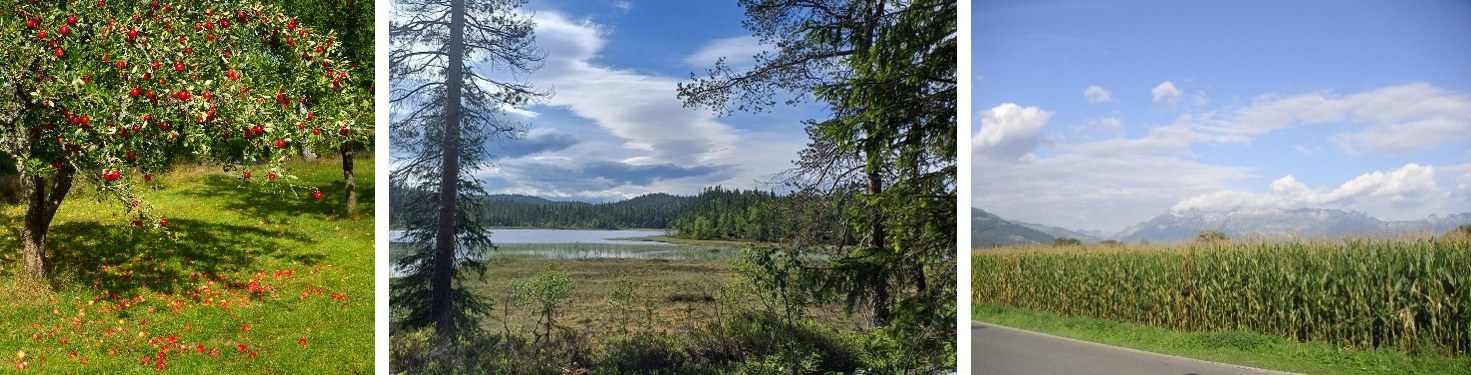
Left: © Tree with red apples by W.carter, CC0 1.0 , no changes were made to the original photo.
Middle: © Peatland in Norway by Sabine Huber, BOKU University.
Right: © Maize field in Liechtenstein by Paranoid, public domain, the photo was cut on the left side.
Different soils regulate the climate in different ways. Their overall impact depends on the balance between carbon storage and greenhouse gas emissions. Peatlands are a remarkable example: waterlogged conditions slow decomposition, allowing enormous amounts of carbon to accumulate over thousands of years. But when these soils are drained or disturbed, this long-term carbon store can rapidly become a major source of carbon dioxide emissions.
If you want to learn more about soil organisms and their impact on climate regulation, take a look at one of the articles by Jansson & Hofmockel (2020), Li et al. (2023), or El-Hawwary et al. (2022).