2.4 — Soil diversity across land covers
Soil diversity and land covers
Page 1 / 6
Soils across different land covers
Soils are highly diverse in their depth, colour, chemistry, and structure. This variability occurs at both global and local scales. How many different soil types do you think there are, and where are you most likely to find them? Explore the map showing the distribution of soils in Europe, together with the collection of 24 soil profile images on the left. For improved resolution, please open the PDF document.
Open the map of major soil types in Europe (PDF)
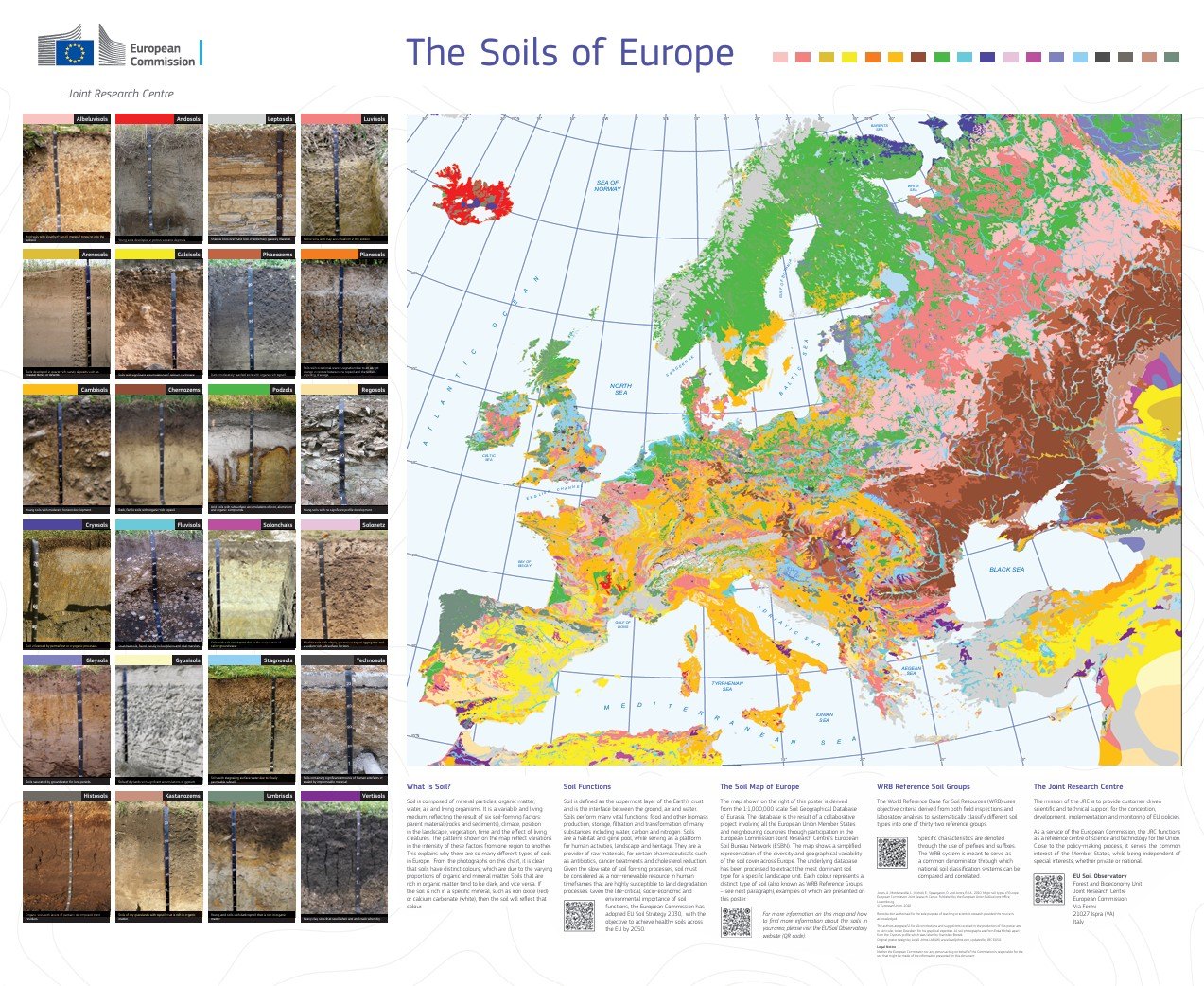
© Jones, A.; Montanarella, L.; Micheli, E.; Spaargaren, O. and Jones, R.J.A., 2010. Major soil types of Europe. European Commission Joint Research Centre. Published by the European Union Publications Office, Luxembourg.
To explore the diversity of soil types further, you are also invited to browse the digital collection “World soil distribution” on the ISRIC webpage.
Soil properties also vary depending on land cover and land-use. The CORINE land cover classification distinguishes several dozen land-cover categories across Europe and represents them in a comprehensive map. Take a look at the map. Can you find the location where you currently live?
In this lesson, we will only scratch the surface of soil diversity, focusing on six selected land covers: woodland, cropland, urban areas, drylands, peatlands, and grasslands. According to Eurostat’s area statistics for 2022, 81% of the European Union was covered by woodland, cropland, and grasslands (Eurostat, 2022).
Now let’s explore how soil properties vary across these selected land cover types.