2.3 — Soil biodiversity
The hidden network of soil life: Understanding the soil food web
Page 2 / 3
The Underground Menu: Who eats whom?
The many organisms living in soil do not exist in isolation. They are linked through various feeding relationships and other interactions that together form the soil food web. As with food webs above ground, the soil food web shows how energy and nutrients move through an ecosystem. Unlike many above-ground food webs, however, much of the activity in soils begins with the decomposition of dead organic matter.
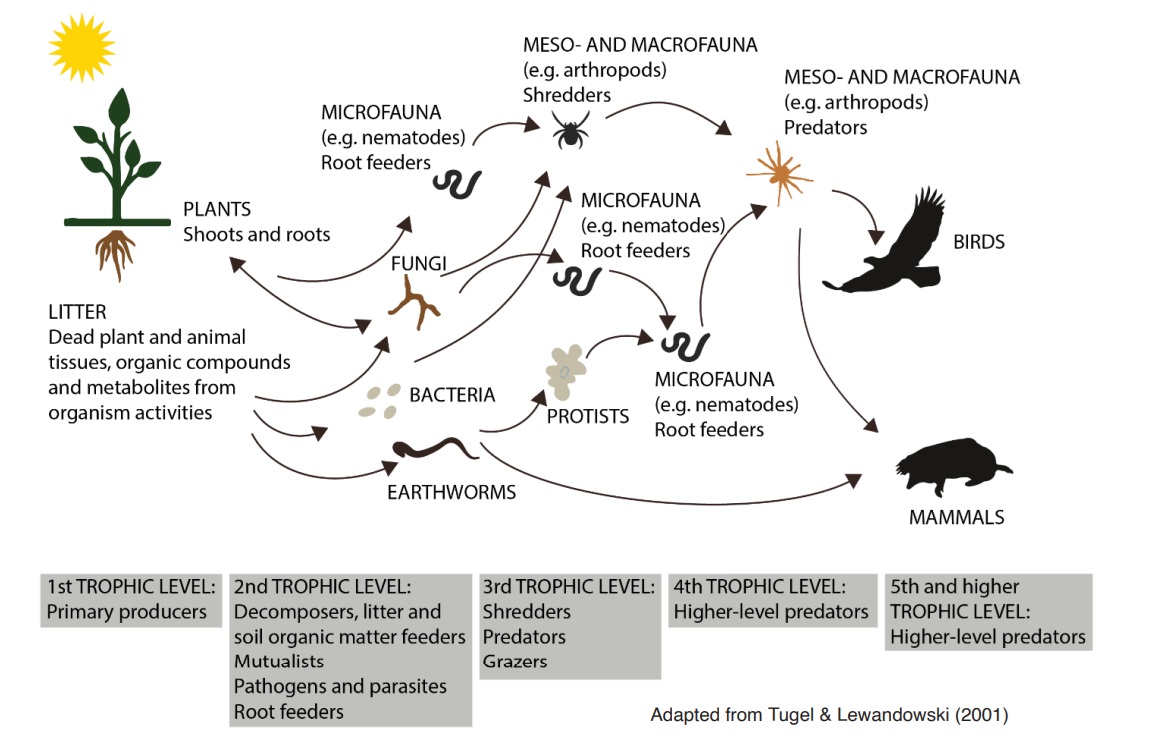
© Soil biota form complex food webs that sustain ecosystem functions, from Common ground: Restoring land health for sustainable agriculture by IUCN.
At the base of the food web, microorganisms – such as bacteria, archaea, and fungi – break down plant and animal remains. During decomposition, nutrients are released and transformed into forms that become available to other organisms, including plants. Many fungi form extensive networks of microscopic filaments called hyphae, which transport water and nutrients through the soil. Mycorrhizal fungi live in close association with plant roots, supplying plants with nutrients and water in exchange for sugars produced through photosynthesis.
Microfauna and mesofauna, such as protozoa, nematodes, mites, and springtails, feed on microorganisms and on each other. By grazing on microbial communities, they recycle nutrients and influence microbial activity. Larger organisms, including earthworms and termites, mix organic and mineral material, create pores and tunnels, and modify the physical structure of soils. Predators such as centipedes and beetles help regulate populations of smaller soil animals.
Together, these interactions create a dynamic network that continually transfers energy and matter throughout the soil ecosystem. Rather than acting independently, soil organisms depend on one another through complex feeding relationships and ecological interactions, making the soil food web one of the key foundations of healthy, resilient and functioning soils (Bardgett & van der Putten, 2014; de Vries et al., 2013).
For a more vivid visualisation of the soil food web, visit a Swedish forest by watching the video “59 Degrees Academy: the Soil Food Web”. It was produced by 59 Degrees Academy and is approximately 7 minutes long.