4.3 — Soil, heritage, memory and human connection
Soil from a different perspective
Page 1 / 6
Soil can mean different things
Once soil is examined more closely, it also begins to mean different things. That does not happen by accident. Meanings grow out of what soil’s characteristics, what it makes possible, how people interact with it, and what happens to it in a particular place. Soil does not carry one fixed meaning because it has different qualities, supports different activities, and faces different conditions and pressures.
A garden bed, for example, is rarely understood in the same way as a dusty construction site. In one, soil may be watered, protected, loosened, and enriched so that roots can grow and water can infiltrate. In the other, it may be scraped away, compacted, left exposed, or treated as inconvenience. A riverbank after flooding may be seen as risk or disruption, but also as a place where fine sediment has been deposited and the ground has been reshaped. The soil in a cemetery, a memorial landscape, or an archaeological site may carry meanings connected with memory, loss, burial, and the passage of time.
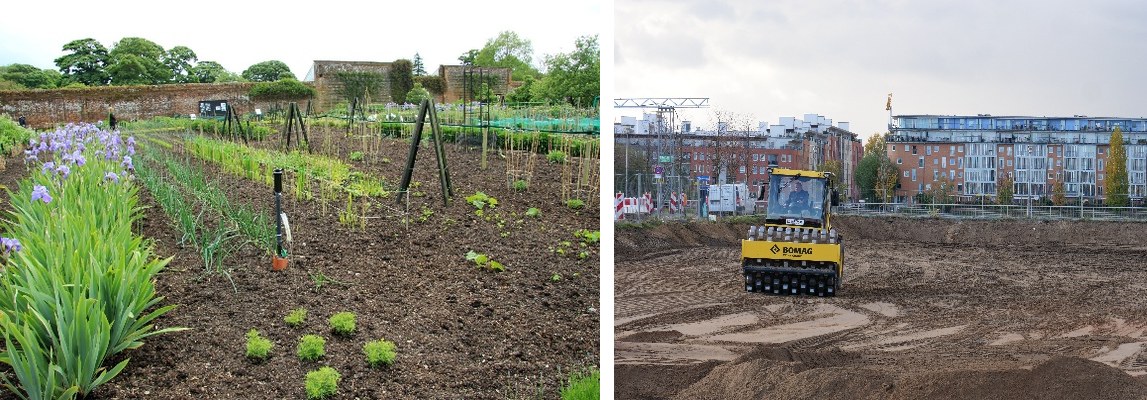
Left: © Walled Garden at Felbrigg Hall, by Karen Roe, CC BY 2.0, via Flickr, no changes were made to the original photo.
Right: © Construction site Daumstraße north, by Leonhard Lenz, CC0 1.0, via Wikimedia Commons, no changes were made to the original photo.
The same is true at a smaller, more personal scale. A child may remember soil through digging, falling, getting muddy, or finding worms. A farmer may understand it through work, crop yield, uncertainty, and dependence on the weather. A gardener may notice whether soil is depleted, rich in organic matter, dry, compacted, or alive with roots and other soil organisms. A commuter may notice soil only when it becomes dust, mud, or stain on the pavement. The soil itself has not changed into something else, but the relationship to it has changed which qualities become visible, important and memorable.
This is why value is never purely technical. Some soils are valued because they support food production, vegetation, buildings, shade, or attractive landscapes. Other become noticeable only when they crack, erode, stain surfaces, or stop performing as expected. Some soils are carefully managed, while others are neglected. Some are treated as heritage, others are removed or treated as waste. What people notice and value in soil depends partly on whether they can recognise what the soil is doing, understand its condition, and how it is being treated.