
1.3 — Regulation
Soil regulates the water cycle: A natural sponge and filter
Page 4 / 6
Soil as a natural water cycle regulator
As water moves through the pore network, its flow slows. Along the way, particles can become trapped, dissolved substances may bind to mineral surfaces or organic matter, and microorganisms can transform or break down some compounds. In this way, soils act as a natural filter, improving water quality before it reaches groundwater, streams and lakes.
Not all dissolved substances and contaminants are removed equally well. Soils can retain sediments, nutrients, and some contaminants, but their filtering capacity is limited and depends on factors such as mineral properties, organic matter content, soil microorganisms and the properties of the pollutant itself. Once these limits are exceeded, pollutants can still reach groundwater or surface waters (Sakar et al., 2021).
One example is excessive nitrogen fertilisation. When more nitrogen is applied than plants can absorb, or when fertilisers are applied shortly before heavy rainfall or irrigation, the excess nitrate can be washed out of the soil. Because nitrate is highly water-soluble, it can then be transported into groundwater or nearby rivers and lakes (Bijay-Singh & Craswell, 2021). Similar losses can occur in grazed pastures, where livestock deposit dung and urine directly onto the soil. High nitrate concentrations can impair drinking water quality and contribute to the eutrophication of aquatic ecosystems.
Would you like to know more about the nitrogen cycle and eutrophication, the process by which a water body receives becomes enriched with excessive nutrients, such as nitrogen? If so, take a look at the article “What is the Nitrogen Cycle and Why Is It Key to Life?” by Aczel (2019). Based on scientific research, the article is written in accessible language and was reviewed by teenagers to ensure it is easy to understand.
The same pore network that filters water also influences flooding. When rainfall infiltrates into the soil, less water flows rapidly across the land surface. Instead, some of the water is stored temporarily and released more gradually through groundwater or streams. This retention reduces peak runoff during heavy rainfall and helps maintain river flow during drier periods. Compare the two surfaces in the photo below: while rainwater can infiltrate into the soil beneath the park or on the meadow, little or no infiltration occurs on the sealed road surface. This makes green spaces important places for storing and regulating rainwater in towns and cities.
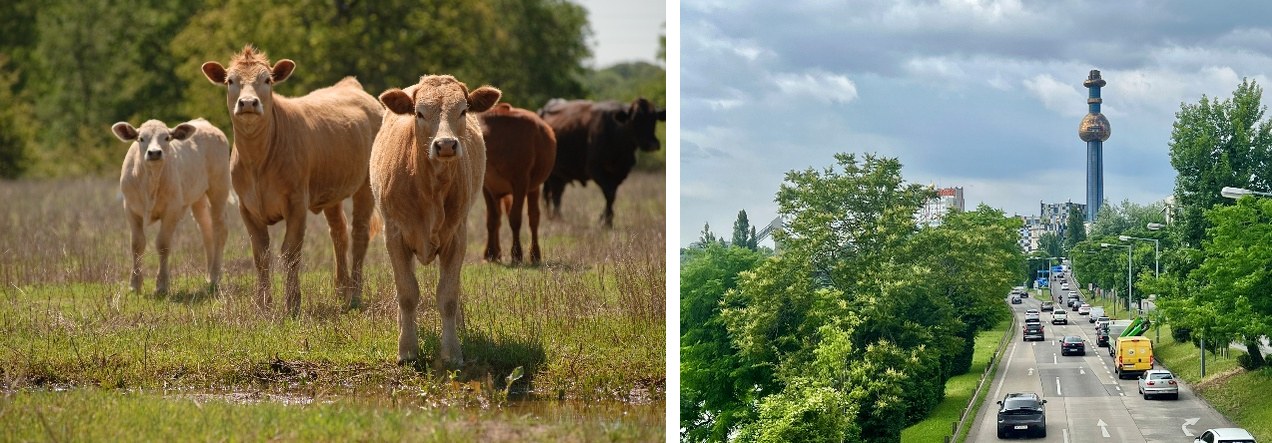
Left: © Cattle in pasture by USDA NRCS Texas, CC BY 2.0, no changes were made to the original photo.
Right: © Road and park in Vienna by Sharon Hahn Darlin, CC BY 2.0, no changes were made to the original photo.
Together, these processes regulate both the quality and quantity of water. By slowing its movement, storing it, filtering out contaminants, and gradually releasing it, soils provide a vital regulating ecosystem service that supports natural ecosystems, agriculture, and society.