3.3 — Biodiversity loss
What is soil biodiversity and why does it matter?
Page 1 / 5
What is a soil food web?
If you completed Module 2, Topic 3 on soil biodiversity, you have already learned what a soil food web is. In this lesson, you will become more familiar with three fascinating groups of soil organisms: earthworms, mycorrhizae and protists. Knowledge about their diversity and their role in ecosystems is expanding rapidly. This lesson provides the basics and is intended to spark your curiosity to learn more about organisms living in soil.
Soils provide habitat for a vast array of organisms that vary in size, activity and function. Soil organisms include both flora and fauna. A soil food web typically consists of primary producers (e.g. roots, seeds and spores of plants and algae) and primary, secondary and higher-level consumers (e.g. earthworms, fungi, bacteria, nematodes, mites and protists).
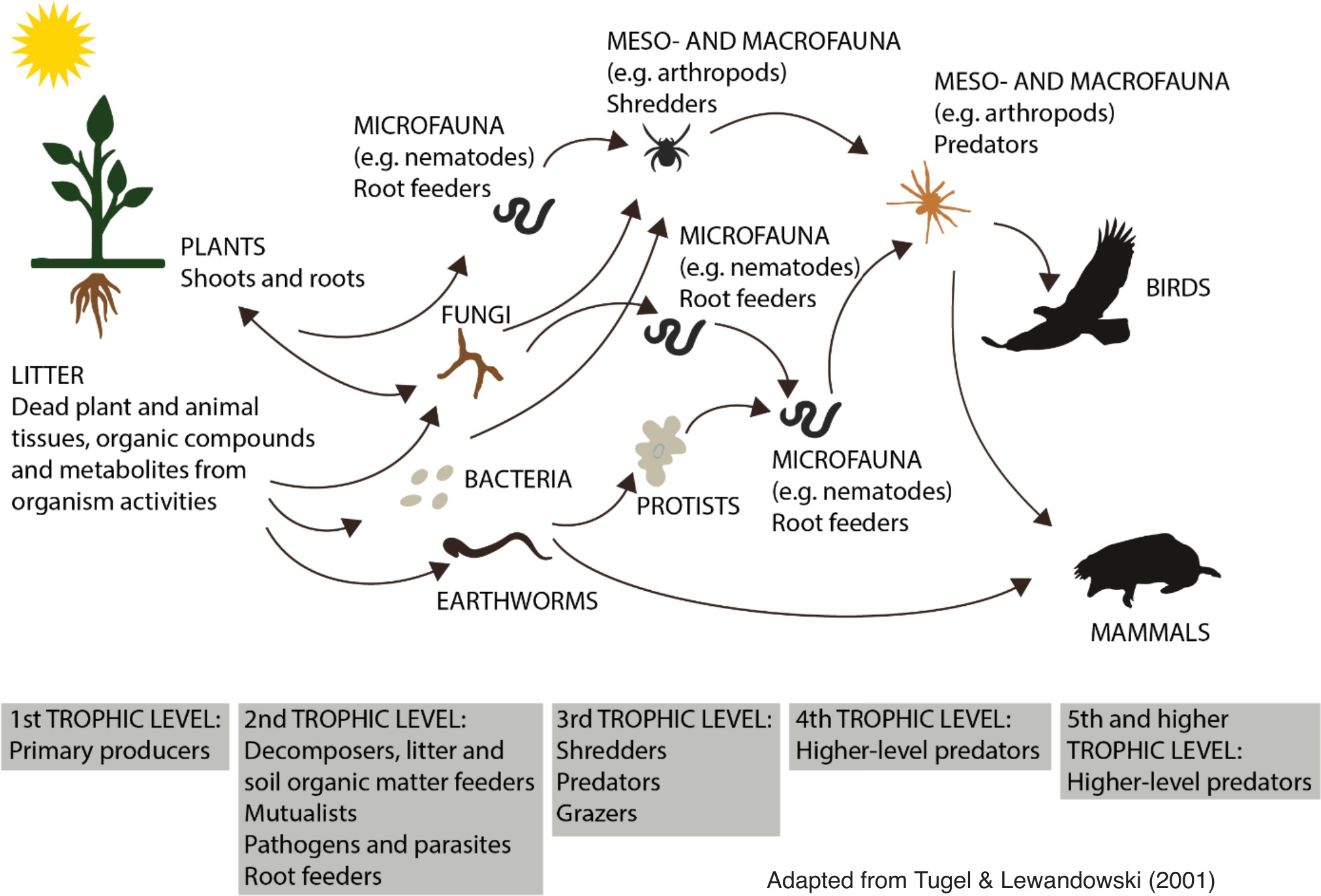
© Soil biota form complex food webs that sustain ecosystem functions, from Common ground: Restoring land health for sustainable agriculture by IUCN.
Watch the short, animated video “The Soil Food Web” (external content), which illustrates soil organisms and the connections between them using clay characters. The video was produced by Maxwell Helmberger in cooperation with the Cornell University Department of Entomology Extension/Outreach Assistantship programme and is approximately 90 seconds long.