
3.3 — Biodiversity loss
Soil protists — the invisible engines of ecosystems
Page 1 / 7
What are protists and what makes them unique?
This lesson is based on Geisen et al. (2017), Geisen et al. (2018), Berlinches de Gea et al. (2025) and Krishnakumaranet et al. (2025). Read these publications, and the citations within them, for detailed protist ecology. First, let’s start with the basics of soil protists.
“A protist is any eukaryotic organism that is not an animal, plant or fungus” according to the report on the state of knowledge of soil biodiversity by FAO, ITPS, GSBI, SCBD and EC (2020). As a reminder, eukaryotes are organisms whose cells contain a nucleus. Protists form a large and diverse group of organisms that include, for example, amoebae, flagellates and microscopic algae. For simplicity, protists can be classified according to how they obtain food and function in the environment:
- Predatory and consumer protist, traditionally called “animal-like” protists – formerly known as protozoa, that are capable of movement and consume other organisms. They are predators of other soil organisms. They play an important role in the soil food web and nutrient cycling.
- Photosynthetic protists, traditionally called “plant-like” protists (e.g. microscopic algae such as diatoms), which use light as their source of energy.
- “Fungus-like” protists (e.g. oomycetes) which resemble fungi in some aspects of their lifestyle. Some species degrade organic matter or infect plants and animals.
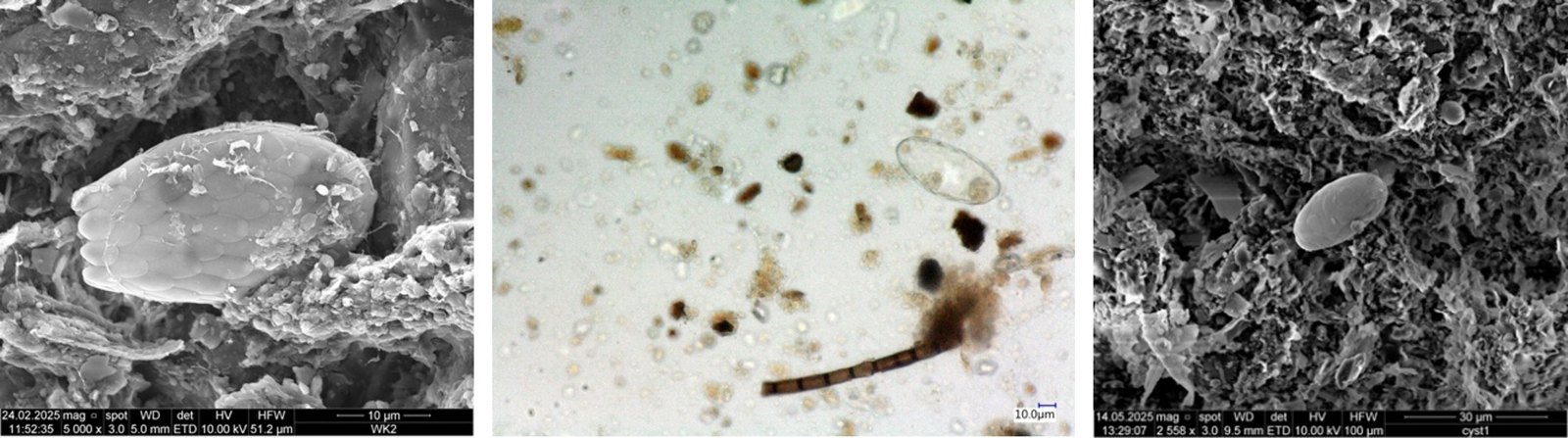
© Testate amoebae, primarily microbial grazers, feeding on bacteria, fungi, algae, and other small soil microorganisms. By Lea Wellinger and Leon Ploszczanski, BOKU University.
Take also a look at Figure 1 in Geisen et al. (2018) and chapter 2.3.5. in FAO, ITPS, GSBI, SCBD and EC (2020) for a comprehensive visual summary of the diverse morphological characteristics of protists.